
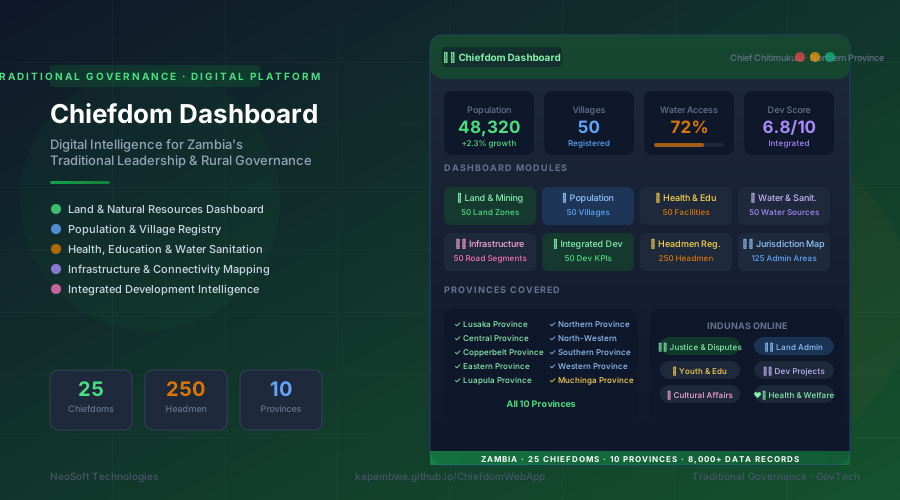
Zambia's traditional leadership system is not a relic of the past — it is a living, functioning layer of governance that reaches into every corner of the country. Chiefs, headmen, and indunas administer land, adjudicate disputes, coordinate development, and serve as the first point of authority for millions of Zambians who live beyond the reach of formal municipal systems.
Yet for all their authority and responsibility, these leaders have historically operated without the digital infrastructure that any serious governance institution demands. Decisions that affect thousands of people have been made on the basis of oral records, paper registers, and institutional memory — with all the fragility and opacity that entails.
The Chiefdom Digital Governance Platform changes that. Built as a live, deployable web application and accessible now at kapambwe.github.io/ChiefdomWebApp, it brings data-driven intelligence to all 25 chiefdoms across every province of Zambia.
Why Traditional Governance Cannot Afford to Remain Analogue
Zambia's traditional leaders govern a significant portion of the national population. Senior chiefs like Chitimukulu in the Northern Province and Chief Mukuni in Southern Province preside over territories with tens of thousands of residents, extensive land holdings, numerous health and education facilities, and complex water and infrastructure needs.
The challenge is not the willingness of traditional leaders to govern effectively — it is the absence of systems that would make effective governance possible at scale. When a headman needs to report on the water situation in his village, he relies on what he can recall or observe. When a chief needs to know how many children are enrolled in schools across 50 villages, there is no dashboard to consult. When a district officer needs to understand which areas have the greatest development deficits, there is no integrated data to guide the decision.
This is not a problem of leadership capacity. It is a problem of infrastructure. The same districts and chiefdoms that struggle with development outcomes are often those with the most engaged traditional leadership — leaders who are frustrated by the absence of the tools they need to translate authority into visible results for their communities.
These are not failures of individual leaders or communities. They are the predictable consequences of governing complex territories without the digital infrastructure that transforms good intentions into measurable outcomes. The Chiefdom Digital Governance Platform is purpose-built to close this gap — not by replacing traditional authority, but by giving it the data intelligence it has always deserved.
25
Chiefdoms Covered
10
Provinces of Zambia
250
Village Headmen
8,000+
Data Records
Live Platform
Chiefdom Dashboard — Live Demo
A fully deployed digital governance platform covering 25 chiefdoms across all 10 provinces of Zambia — with comprehensive dashboards for land, population, health, education, water, infrastructure, and integrated development. Pre-loaded with realistic data for all chiefdoms, accessible and ready for demonstration to government stakeholders.
The Chiefdom Digital Governance Platform does not replace traditional authority. It gives traditional authority the data infrastructure it needs to govern with precision, accountability, and measurable impact.
Six Integrated Dashboards for Complete Chiefdom Governance
The platform is built around six specialised dashboard modules — each addressing a critical dimension of chiefdom governance. Every chiefdom has a dedicated data set, and all six dashboards are loaded, functional, and ready for real-world deployment.
Land & Natural Resources Dashboard
Land is the foundation of chiefdom authority and rural livelihoods. The Land Dashboard provides chiefs and government officials with real-time visibility over every land distribution, conversion application, and mining project within the chiefdom's boundaries. From agricultural allocations to protected zones and industrial concessions, every land transaction is recorded, tracked, and made auditable.
What the Platform Delivers
- Historical land allocation records with approval workflows
- 50 land conversion applications tracked by status
- Land use zone mapping: Agricultural, Settlement, Mining, Protected, Industrial
- 10 active, exploration, and inactive mining project records
- Boundary and area data for planning and dispute resolution
Population & Village Registry
Effective governance starts with knowing exactly who lives in a community and where. The Population Dashboard digitises every village in the chiefdom — with GPS coordinates, population counts, household numbers, village heads, distance to key services, and infrastructure access ratings. This is the data foundation that makes targeted development interventions possible.
What the Platform Delivers
- Full chiefdom population demographics and growth trends
- 50 village profiles with GPS coordinates and household data
- Village head and community leadership records
- Distance-to-services metrics (clinics, schools, markets)
- Infrastructure access classification per village
Health & Education Dashboard
Every health facility and school in the chiefdom is mapped, measured, and monitored. The Health & Education Dashboard tracks bed capacity, staffing levels, patient volumes, school enrolment, teacher-to-pupil ratios, and academic performance — giving district health and education offices the intelligence they need to allocate resources where they will have the most impact.
What the Platform Delivers
- 50 health facilities: hospitals, clinics, health posts
- Bed capacity, staff numbers, and patient volume metrics
- Services offered per facility with coverage zone data
- 50 education facilities: primary, secondary, community schools
- Enrolment, capacity, teacher ratios, and academic performance metrics
Water & Sanitation Dashboard
Access to clean water is one of the most critical development indicators for rural Zambia. The Water & Sanitation Dashboard maps every borehole, piped water system, well, and natural spring in the chiefdom — recording population served, water quality test results, functional status, and maintenance history. Decision-makers can identify water-stressed areas and prioritise infrastructure investments with precision.
What the Platform Delivers
- 50 water sources: boreholes, piped water, wells, springs
- Population served, flow rates, and water quality data per source
- Functional status tracking and maintenance history records
- 10 natural water body records
- 50 sanitation facility profiles and water access zone metrics
Infrastructure & Connectivity Dashboard
Rural infrastructure is the nervous system of chiefdom development — roads that connect communities to markets, bridges that survive the rainy season, and mobile towers that bring connectivity to remote villages. The Infrastructure Dashboard provides a complete picture of every road segment, communication tower, bridge, and connectivity zone in the chiefdom, with condition ratings and network coverage metrics.
What the Platform Delivers
- 50 road segments with surface type, condition, and maintenance status
- 50 mobile network towers with operator and coverage data
- 10 bridge infrastructure records with structural condition ratings
- 50 connectivity zones with network coverage classification
- Infrastructure gap mapping for government investment prioritisation
Integrated Development Dashboard
The Integrated Development Dashboard brings all data streams together into a unified development intelligence view. Every village receives a multi-dimensional development score, a priority ranking, and a needs assessment — enabling chiefs, headmen, and government planners to allocate resources rationally and track development progress over time. This is the dashboard that transforms chiefdom governance from reactive to strategic.
What the Platform Delivers
- 50 village development profiles with composite scoring
- Priority rankings and needs assessment per village
- 50 key development performance indicators (KPIs)
- 50 identified risk zones with intervention recommendations
- Cross-dashboard analytics aggregated into a single national view
Three Digital Registries That Formalise Traditional Leadership
Beyond the six dashboards, the platform provides three foundational registries that digitise the human architecture of traditional governance — the headmen who administer villages, the indunas who advise the chief, and the jurisdiction maps that define territorial authority.
250
Village Headmen
Headmen Registry
A comprehensive digital record of all 250 village headmen across the 25 chiefdoms — covering jurisdiction boundaries, population under authority, assigned Induna, years in service, contact details, and GPS-referenced responsibilities.
20
Traditional Counsellors
Indunas Registry
The Indunas — traditional advisors specialising in Land Administration, Justice & Disputes, Development & Projects, Cultural Affairs, Youth & Education, and Health & Welfare — are digitally profiled with their case metrics, assigned villages, and jurisdiction areas.
125
Administrative Areas
Jurisdiction Maps
Every chiefdom is subdivided into clearly defined administrative areas with GeoJSON-compatible boundary coordinates, land area measurements in hectares, population data, assigned headmen and indunas, neighbouring areas, and key landmarks.
25 Chiefdoms Across All 10 Provinces of Zambia
The platform is not a pilot for a single province — it is a national-scale system. Every chiefdom has a complete, realistic data set covering all six dashboard categories, enabling demonstration, deployment, and government adoption at scale from day one.
Lusaka Province
- 👑 Chieftainess Nkomesha
- 👑 Chief Chipepo
Central Province
- 👑 Chief Chitanda
- 👑 Chief Chiundaponde
- 👑 Chief Mukobela
Copperbelt Province
- 👑 Chief Mushili
- 👑 Chief Chiwala
- 👑 Chief Nkana
Eastern Province
- 👑 Chief Madzimawe
- 👑 Chief Nzamane
- 👑 Chief Kawaza
Luapula Province
- 👑 Chief Mwewa
- 👑 Chief Kashiba
- 👑 Chief Kabanda
Northern Province
- 👑 Senior Chief Chitimukulu
- 👑 Chief Tafuna
- 👑 Chief Mwamba
North-Western Province
- 👑 Chief Ishindi
- 👑 Chief Kasempa
- 👑 Chief Sailunga
Southern Province
- 👑 Chief Mukuni
- 👑 Chief Monze
- 👑 Chief Cooma
Western Province
- 👑 Chief Inyambo Yeta
- 👑 Chief Sikufele
Muchinga Province
- 👑 Chief Muyombe
- 👑 Chief Kopa
Why This Matters for Zambia's Development Agenda
Zambia's Eighth National Development Plan (8NDP) places rural development, community empowerment, and improved service delivery at its core. The National Decentralisation Policy calls for effective multi-tier governance that brings services closer to citizens. The Vision 2030 ambition of becoming a middle-income country cannot be achieved without transforming how the majority of Zambians — who live in rural chiefdom areas — experience governance.
The Chiefdom Digital Governance Platform is the missing link between national development policy and local delivery reality. It does not require a new bureaucracy or a new tier of government. It works through the traditional leadership structures that already exist and already command community trust — by giving those structures the digital intelligence to act on evidence rather than instinct.
For the Ministry of Chiefs and Traditional Affairs, this platform provides a tool to standardise governance quality across all chiefdoms. For the Ministry of Local Government and Rural Development, it provides the data infrastructure to allocate resources where they will have the most impact. For the Office of the President, it provides real-time visibility into development progress in areas that have historically been invisible in national monitoring systems.
“Zambia's chiefs have governed their people for generations. The question is not whether they should continue to do so — it is whether we will give them the tools that every modern governor needs to serve their people well.”
— NeoSoft Technologies, Lusaka
Built for Real-World Deployment
The Chiefdom Dashboard is not a prototype — it is a production-ready application built on modern web technology. The platform is a enterprise web platform application that runs in any web browser, with no installation required. All data loads from structured JSON files, meaning it can operate in low-connectivity environments without a live database connection.
The data architecture is designed for easy migration to live API endpoints when the government is ready to connect to real-time data sources. Each service layer has a clean fallback mechanism — ensuring the platform remains functional even during connectivity interruptions.
The system is pre-loaded with realistic data for all 25 chiefdoms — over 8,000 individual records across land, population, health, education, water, infrastructure, and development categories. Every record uses realistic Zambian place names, GPS coordinates within valid ranges, and data values that reflect actual service delivery conditions in rural Zambia.
152
Total JSON Data Files
300+
Records Per Chiefdom
6
Dashboard Categories
10
Headmen Per Chiefdom
125
Jurisdiction Areas
6
Indunas Specialisations