
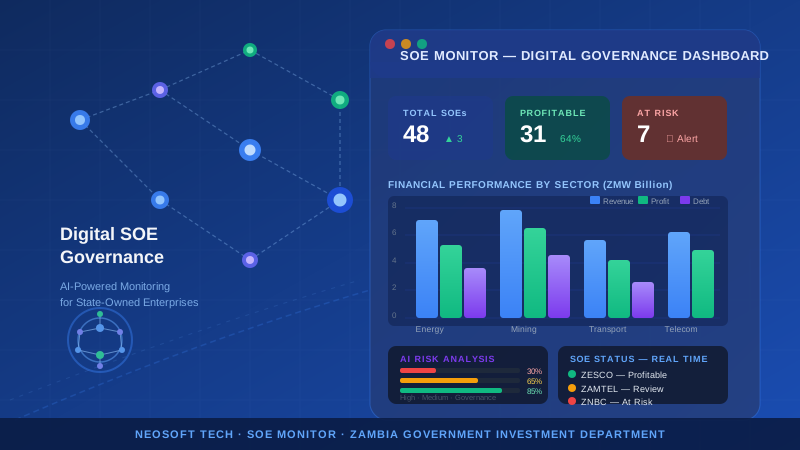
Zambia's proposed State-Owned Enterprises Bill introduces important reforms to improve the governance, transparency, and accountability of government-owned companies. The bill proposes the creation of a Government Investment Department to oversee state investments and strengthen how State-Owned Enterprises (SOEs) are managed.
However, managing SOEs effectively requires more than policy frameworks. It requires modern digital systems that can collect, analyze, and monitor data in real time.
Featured Platform
SOE Monitor Web Application
Designed to help the Government Investment Department and other oversight bodies monitor, evaluate, and manage state-owned enterprises more effectively through a unified digital platform.
Why SOEs Matter to Zambia
State-owned enterprises are critical to Zambia's economy, operating in sectors that touch every citizen's daily life. If managed effectively, they can drive economic growth, create jobs, and generate revenue for the government.
Eight Ways the System Transforms SOE Oversight
Centralized Registry of All SOEs
How It Works
One of the biggest challenges governments face is the lack of a centralized record of all state-owned enterprises. The system creates a national registry capturing company name, sector, ownership structure, shareholding percentages, board members, establishment date, and legal status.
Key Outcomes
- ✓Know exactly how many SOEs exist
- ✓Track government investments across all sectors
- ✓Ensure ownership structures are transparent
- ✓Monitor changes in leadership and governance
Monitoring Financial Performance
How It Works
State-owned enterprises manage billions in public assets. The system enables the Government Investment Department to monitor key financial indicators — revenue, operating costs, profit or loss, debt levels, government subsidies, and capital investments.
Key Outcomes
- ✓Identify which SOEs are profitable
- ✓Detect SOEs with excessive reliance on government support
- ✓Spot declining financial performance early
- ✓Enable corrective action before crises develop
Strengthening Corporate Governance
How It Works
Many governance challenges in SOEs arise from unclear board responsibilities, poor oversight, and lack of performance tracking. The platform includes governance monitoring tools that track board appointments, tenure, meeting attendance, compliance, and performance evaluations.
Key Outcomes
- ✓Ensure boards remain accountable
- ✓Maintain transparency in leadership appointments
- ✓Uphold governance standards across all SOEs
- ✓Create verifiable records of board decisions
Public Interest Service Obligations
How It Works
Some SOEs provide essential services — electricity, water, transport, public broadcasting — that may not always be commercially profitable. The system tracks service delivery targets, government subsidies supporting these services, and operational costs versus public benefit.
Key Outcomes
- ✓Balance financial sustainability with public service
- ✓Justify subsidies with measurable outcomes
- ✓Hold SOEs accountable for service delivery
- ✓Inform policy on public utilities
Risk Detection and Early Warning
How It Works
The system can flag warning signs such as declining revenues, increasing debts, governance violations, delays in reporting, and excessive reliance on government funding — enabling the Government Investment Department to intervene before problems escalate.
Key Outcomes
- ✓Proactive rather than reactive oversight
- ✓Prevent financial crises before they emerge
- ✓Protect public assets from mismanagement
- ✓Reduce the cost of SOE bailouts
Transparency and Parliamentary Reporting
How It Works
The system automatically generates annual SOE performance reports, financial summaries, sector comparisons, and governance compliance reports — shareable with Parliament, the Ministry of Finance, the Auditor General, and other oversight institutions.
Key Outcomes
- ✓Strengthen democratic accountability
- ✓Enable Parliament to exercise effective oversight
- ✓Reduce delays in statutory reporting
- ✓Create a permanent audit trail
Data-Driven Decision Making
How It Works
With the system, policymakers can answer critical questions: Which SOEs should receive additional investment? Which enterprises need restructuring? Which sectors need policy intervention? This transforms SOE management from reactive governance to strategic, data-driven management.
Key Outcomes
- ✓Base investment decisions on verified data
- ✓Identify restructuring candidates objectively
- ✓Allocate resources to highest-impact SOEs
- ✓Move from reactive to strategic governance
Integration With National Digital Infrastructure
How It Works
The system can integrate with national accounting systems, procurement systems, tax systems, and digital identity platforms — creating a complete digital ecosystem for managing public enterprises.
Key Outcomes
- ✓Eliminate duplicate data entry across systems
- ✓Enable cross-platform data validation
- ✓Build a unified government digital backbone
- ✓Support future e-government initiatives
Oversight Chain
Digital monitoring creates an unbroken accountability chain from enterprise to Parliament.
The Future of SOE Governance in Zambia
By combining the State-Owned Enterprises Bill with a digital monitoring system, Zambia can:
- ✓Improve transparency
- ✓Strengthen governance
- ✓Reduce corruption risks
- ✓Improve financial performance of SOEs
- ✓Ensure public assets are managed responsibly
The SOE Monitor System transforms SOE management
from manual, fragmented oversight
into a modern, data-driven governance framework.